Data Entry Notice: This forensic analysis contains curated affiliate links to 100% licensed retail partners. As an associate, the Archive earns from qualifying purchases.
Is Zenon Zogratis truly evil, or is he the inevitable biological byproduct of a kingdom built on the fear of annihilation?
In the forensic study of power, most antagonists fail due to emotional interference. Dante seeks malice; Vanica seeks cruelty. But Zenon? Zenon seeks only the Objective Truth of Strength. To understand him is to realize that his coldness isn’t a personality trait—it is an act of resistance. He has performed a clinical amputation of his own empathy to survive a world that views mercy as a terminal illness.
At Mirari’s Archive, we have analyzed the data from the massacre of the Golden Dawn to the final collapse of the Spade Kingdom. Zenon is not merely a villain; he is a sociopathic architect of a new world order where “effort” is redefined as the cold, repetitive labor of self-erasure.
Table of Contents
- The Boy Before the Monster: Adaptive Psychology
- The Anatomy of Labor: Strategic Persistence in the Face of Systemic Exclusion
- The Bone Magic Asset: Rigidity as a Psychological Weapon
- Allen’s Death and the Forensic Pathology of Trauma
- The Golden Dawn Massacre: Clinical Superiority vs. Individual Agency
- Final Verdict: The Death of Self in the Pursuit of Totality
- Frequently Asked Questions
The Boy Before the Monster: Adaptive Psychology
Before he became the most efficient enforcer of the Dark Triad, Zenon was a child trying to reconcile a sensitive spirit with a collapsing state. Unlike his siblings, Zenon showed hesitation. He showed doubt.
His transition into a monster was not a sudden descent into madness, but a calculated response to national instability. In the Spade Kingdom, compassion looked irresponsible. To remain “human” was to remain a target.
Archive Analysis: Zenon’s tragedy works because his humanity became a liability. Black Clover doesn’t present his transformation as a sudden embrace of evil. It shows a system gradually teaching him that compassion is inefficient, hesitation is dangerous, and survival requires emotional removal. Zenon responds by optimizing himself for the world that created him—until becoming an effective soldier means becoming less human. That makes Zenon an interesting contrast to Asta’s refusal to accept the system’s definition of weakness.
The Anatomy of Labor: Strategic Persistence in the Face of Systemic Exclusion
Zenon’s worldview can be summarized in one brutal equation: Humanity creates hesitation. Hesitation creates death. While Asta believes that effort allows one to protect others, Zenon believes that true effort is the strength required to sacrifice those you love for the “greater” survival of the state.
He treats violence with the precision of a mathematician. He is the dark mirror to Asta’s “never give up” philosophy; Zenon never gave up on the idea that strength was the only objective reality.
Forensic Note: Zenon represents authoritarian survival logic. He isn’t a nihilist who believes in nothing—he is an ideologue who believes suffering is a necessary fuel for stability. By amputating his empathy, he became the ultimate “Alpha Enforcer,” proving that strategic persistence doesn’t make you special; it gives you a chance to become something beyond human.
Compare this to the Forensic Profile of Nacht Faust, whose own relationship with Devils explores the boundary between necessary evil and total corruption.
The Bone Magic Asset: Rigidity as a Psychological Weapon
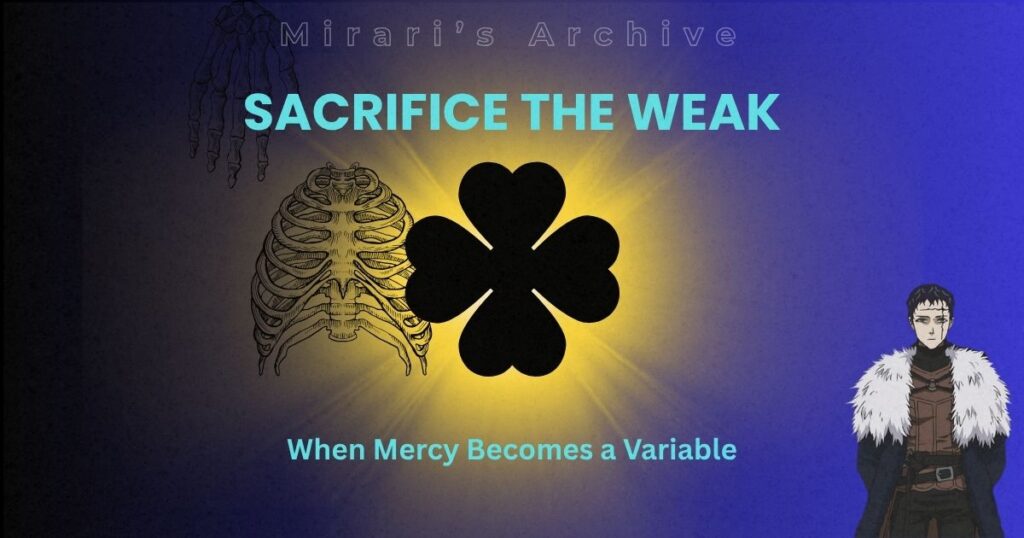
Forensically, Bone Magic is the most fitting attribute for a man who has emotionally fossilized himself. Bones symbolize structure, rigidity, and the internal framework that supports life. Zenon weaponizes that framework, making the internal—external and lethal.
While fire magic is expansive and wind magic is elegant, Bone Magic is invasive and restrictive. It turns the body itself into a cage. Zenon doesn’t just fight his opponents; he occupies the space they inhabit, negating their ability to fight properly.
Zenon’s magic is “Psychological Architecture.” Much like how the grimoire system reinforces social class, his Bone Magic rewards those who are unyielding. When paired with Spatial Mana Domination, it represents total environmental control. He has built a prison of bone, and the terrifying reality is that he is the first inmate to be trapped within it.
Archive Analysis: Zenon’s Spatial Magic is not merely a tactical utility; it is a physical manifestation of his refusal to allow external variables—including human will—to disrupt his calculated environment.
In behavioral science, the concept of Proxemics dictates how individuals use space to communicate power. Zenon’s “Spatial Mana Domination” is the ultimate expression of the High-Status Dominance Display. By negating the mana of others within his territory, he creates a vacuum where only his rules exist. This isn’t just about winning a fight; it is about the systematic erasure of the opponent’s agency.
While most mages interact with their environment, Zenon smothers it. This reflects a psychological need for absolute predictability—a byproduct of his childhood trauma in a volatile Spade Kingdom. If he controls the space, he controls the outcome. This obsession with environmental mastery suggests a man who views the world as inherently chaotic and untrustworthy, leading him to believe that peace can only exist within the confines of a cage he has built himself.
Allen’s Death and the Forensic Pathology of Trauma
The death of Allen is the emotional core that justifies Zenon’s descent. Allen represented hope, partnership, and the belief that strength could coexist with kindness. When Zenon sacrificed Allen, he wasn’t just killing a friend; he was executing his own future as a protector.
Rather than processing grief, Zenon converted trauma into a permanent ideology. He rationalized the loss by deciding that Allen died because they were “too weak” to be human.
This is trauma rationalization at a terminal level. Zenon doesn’t seem proud of his choice; he simply believes there was no other option. This distinction is why he remains the most tragic member of the Dark Triad. He is a failed protector archetype who destroyed his humanity to save a kingdom that was already hollow.
Forensic Note: The transition from Human to Devil Heart is the final stage of Cognitive Decoupling, where Zenon successfully severs his moral identity from his executive actions.
Zenon’s contract with Beelzebub represents a clinical case of Identity Foreclosure. To function as the Spade Kingdom’s ultimate weapon, Zenon had to “kill” the version of himself that mourned Allen. In psychology, this is known as moral disengagement. He no longer views his massacres as “murder,” but as “resource management.” By trading his human heart for a Devil Heart, he literalized the internal process of turning his empathy into a necrotic organ.
This section of the Archive highlights the “Devil Heart” as more than a power-up—it is a Psychological Prosthetic. It replaces the vulnerability of human grief with the artificial stability of demonic nihilism. Zenon is the “Perfect Soldier” gone wrong; a man who followed the logic of “sacrifice for the greater good” until the only thing left to sacrifice was his own soul. He is a warning of what happens when a person treats their own emotions as “system errors” to be patched out.
The Golden Dawn Massacre: Clinical Superiority vs. Individual Agency
The invasion of the Golden Dawn base was not a battle—it was a clinical removal of authority. Zenon entered like an execution order given human form. While Dante seeks entertainment, Zenon seeks efficiency.
The massacre serves as a narrative filter. It strips away the Shonen illusion that “effort” always results in victory. Sometimes, the “Absolute Logic of Death” wins. For Yuno, this became the moment where the Magic Knight squads’ authority was proven brittle in the face of a man who had already surrendered his soul.
While Asta’s Growth Metrics focus on the accumulation of external bonds, Zenon’s strength is derived from the systematic pruning of them.”
Final Verdict: The Death of Self in the Pursuit of Totality
Zenon Zogratis resonates because he feels possible. He represents what happens when fear and environment convince a human being that compassion is a luxury they cannot afford. He represents the “Devil Heart” transformation not as a power-up, but as a total surrender of identity.
The stronger he became, the less he existed. In the end, he was a man who lost the very thing he was trying to protect: the right to be human.
Insight: Forensic analysis reveals that Zenon’s Bone Magic serves as a literal and metaphorical exoskeleton, protecting a core that he deems too fragile for the reality of war.
From a psycho-somatic perspective, Zenon’s magic attribute is fascinating. Bones are the last things to decay; they are the permanent records of a life once lived. By weaponizing his bones, Zenon is projecting his internal “rigidity” outward. This is Reaction Formation on a grand scale—he feels so much internal instability from his past that he forces his very cells to become unyielding, sharp, and impenetrable.
Unlike the fluid, adaptive nature of Asta’s anti-magic or Yuno’s wind, Zenon’s magic is Statist. It demands that the world stop and conform to his structures. It is the magic of a man who has decided that “flexibility” is synonymous with “weakness.” In our forensic audit, we categorize Bone Magic as “Defensive Aggression.” Every bone spear he launches is an attempt to keep the world at a distance, ensuring that nothing—not friendship, not mercy, and certainly not hope—can ever get close enough to hurt him again.
Frequently Asked Questions
Is Zenon Zogratis stronger than Dante or Vanica?
In terms of raw output and tactical efficiency, Zenon is often considered the most formidable of the Triad. While Dante and Vanica are prone to emotional outbursts or playing with their food, Zenon focuses on immediate termination. His combination of Bone Magic and Spatial Domination makes him nearly impossible to counter without specialized Anti-Magic or higher-dimensional spells.
Is Zenon really dead in the manga?
Following the final showdown in the Spade Kingdom arc, Zenon’s physical form and Devil Heart were destroyed. However, his philosophical impact remains the greatest scar on Yuno’s journey, serving as a reminder that the “Wizard King” path requires more than just strength—it requires the preservation of the heart Zenon threw away.
Lead Curator’s Note: Mirari’s Archive is a professional, reader-supported platform focused on forensic lore analysis and asset preservation.
Affiliate Disclosure: We are an official partner and verified associate of Involve Asia, Amazon, CDJapan, Solaris Japan, and Play-Asia. When you purchase 100% licensed collectibles or media through our curated data links, we earn a small qualifying commission at no additional cost to you. This economic support directly funds the Archive’s computational maintenance and deep-dive audits.
Copyright & Fair Use Disclaimer: All character imagery, manga panels, and promotional assets relating to Black Clover featured across this site are the exclusive intellectual property of Yuki Tabata, Shueisha, Studio Pierrot, and their respective licensing partners. These assets are utilized strictly under Fair Use guidelines for the transformative purposes of critical analysis, educational commentary, and forensic scholarship. No copyright infringement is intended.
Surpass your limits. Abide by the Archive’s Law.